 AESAAportaciones Especiales
01 / Laser deposition
Laser cladding services for industrial components
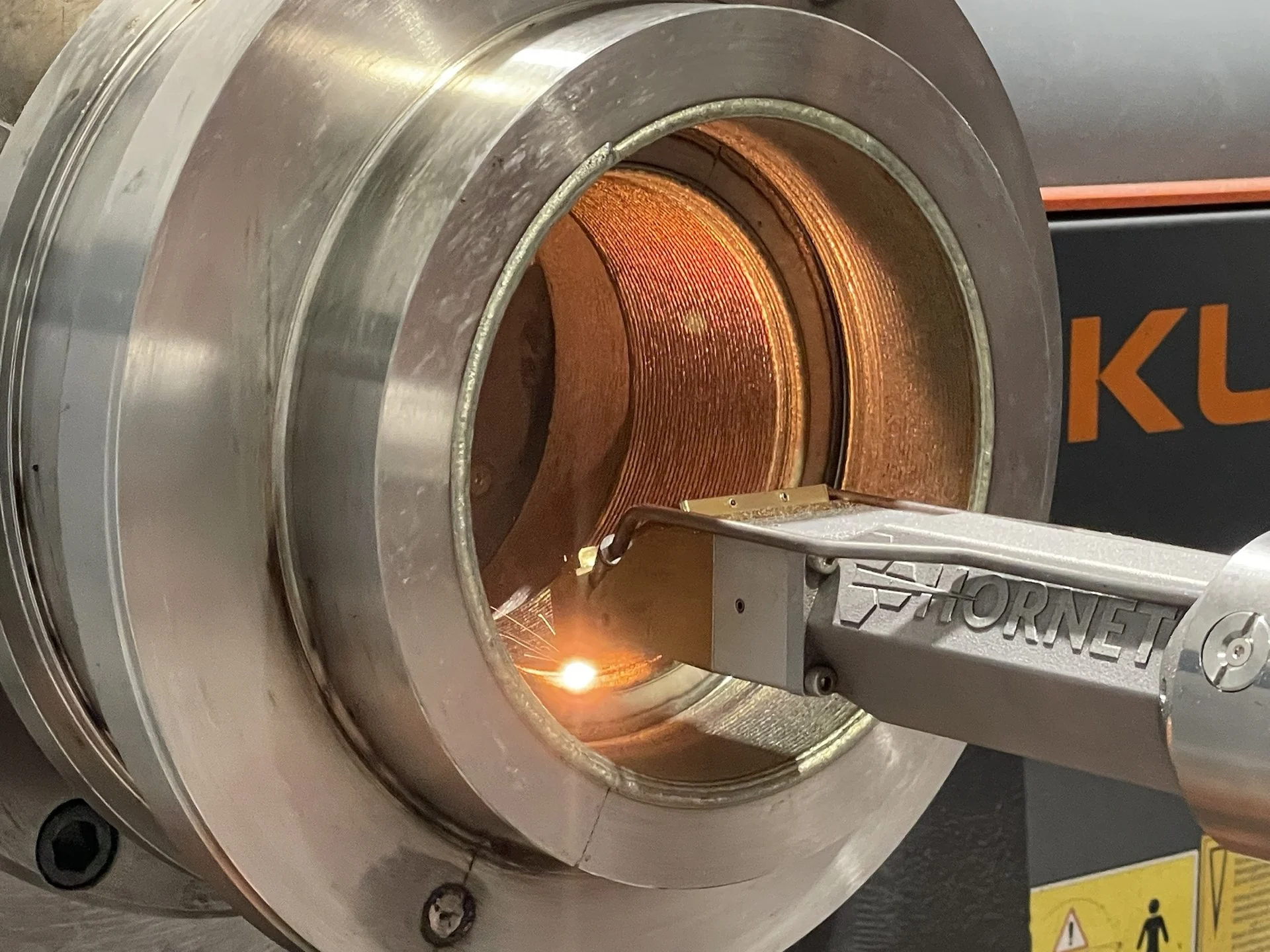
Robotised laser cladding for new components and component repair.
Request a Quote ↗A laser beam creates a localised melt pool on the component. Metal powder is fed through the nozzle, melts and bonds to the base material. AESA uses this controlled deposition process to create a functional surface on new components or restore damaged areas.
Technical information
Laser Cladding / DLD
Applications and process selection
External and internal surfaces are assessed against component geometry and deposition-head access. Applications include shafts, sleeves, and pump and valve components; process selection requires the substrate material, component function and service conditions.
Laser cladding should be selected after assessing substrate condition, access, thermal response and finishing requirements. Where the required function calls for a sprayed coating rather than a fusion-bonded deposit, HVOF or APS may be considered. PTA provides another fusion-cladding option, subject to component requirements.
AESA application: super duplex impeller with Stellite 6 →Component dimensions and head access
- Maximum component length
- 3000 mm
- Maximum component diameter
- Ø 700 mm
- Minimum bore diameter for head access
- Ø 73 mm
- Maximum internal deposition length
- 600 mm
Feasibility is reviewed against component geometry, workholding, surface access and job requirements. Maximum length and diameter do not establish feasibility for every combination. Head-access diameters are not finished bore dimensions.
Representative materials
- Stellite 1, 6 and 12
- Inconel 625
- Tungsten 60/40: 60% tungsten and 40% nickel-based matrix
- Ultimate
Coating selection and applications
- Stellite grades are selected for wear, metal-to-metal sliding and galling resistance. Typical applications include valve seats and contact surfaces; impact loading and service temperature also influence grade selection.
- Inconel is considered when corrosion resistance is the priority. Grade selection requires details of the process fluid, temperature and final deposit chemistry, which can be affected by dilution from the substrate.
- Nickel-based tungsten 60/40 is considered for surfaces exposed to abrasion. Selection requires review of the powder data sheet and loading conditions. Recommendations for Ultimate depend on the specific product reference and its technical data sheet.
- Laser cladding deposits material locally to restore worn areas or add a functional surface to new components. External and internal surfaces are assessed according to deposition-head access, geometry and the required finish.
- Selection guidance: material, thickness, preparation and inspection requirements are confirmed for each component. Cladding alloy families cannot be substituted without reviewing the service conditions.
Capacity and applications
- Specified deposit thickness: 3 mm on diameter, equivalent to 1.5 mm radial
- Functional surfaces on new components, with properties determined by the selected cladding material
- Repair of high-value industrial components
Technical enquiries
Frequently asked questions
Can you clad internal surfaces?
Yes. The minimum bore diameter required to introduce the laser cladding head is 73 mm. The maximum internal deposition length is 600 mm. These are head-access and deposition-reach limits, not finished bore dimensions; feasibility is assessed against the actual component geometry.
Can you machine or grind the component after cladding?
AESA integrates CNC machining and grinding with cladding operations. The process sequence and final finish are defined for the component and deposited material.
Do you use laser cladding on new components?
Yes. One AESA application is localised Stellite 6 deposition on a new super duplex impeller. For other components, the required surface function is reviewed before selecting the deposit.
Do you accept one-off components?
Yes. AESA accepts one-off components. Feasibility and scope are assessed against the component and its requirements.
How soon will you respond to an RFQ?
Our usual RFQ response time is three working days. Manufacturing or repair lead time is established in the quotation.
Do you work with customers outside Spain?
Yes. AESA works internationally. Please include the country of origin, component location and delivery requirements in your enquiry.
What documentation and traceability do you provide?
AESA provides certificates relating to the base material, deposition material and quality control for the job. Our integrated management application identifies the cladding batch applied to each component. Documentation and inspection requirements are reviewed with the order.
What should I include in an RFQ?
Include the component, known material, quantity, dimensions, service conditions and required outcome. Drawings can be sent to aesa@aportaciones-especiales.com. The website form does not support file attachments.