 AESAAportaciones Especiales
02 / Thermal spray
HVOF coating services for industrial components
Protective coatings applied using a high-velocity spray process.
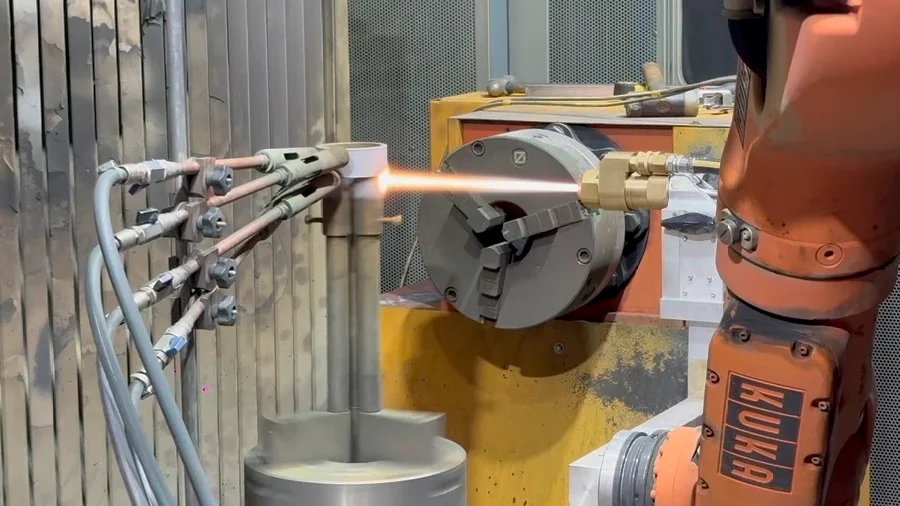
Request a Quote ↗In HVOF (High Velocity Oxy-Fuel) spraying, fuel and oxygen generate a high-velocity jet. Powder particles are heated and propelled onto the prepared surface to form a coating. Their high kinetic energy produces dense coatings for surfaces exposed to wear or corrosion.
Technical information
HVOF
Applications and process selection
Selection depends on the substrate, wear mechanism, process fluid, temperature and required finish. Pump and valve components also require clear specifications for fit or sealing surfaces and dimensions after coating.
HVOF should not be treated as structural crack repair or an automatic substitute for fusion cladding. Substrate condition, geometry and preparation must permit coating deposition and finishing. Laser cladding and PTA are compared where a fusion-bonded deposit is required; APS is assessed for ceramic surface functions.
Component dimensions
- Maximum component length
- 3000 mm
- Maximum component diameter
- Ø 700 mm
Feasibility is reviewed against component geometry, workholding, surface access and job requirements. Maximum length and diameter do not establish feasibility for every combination.
Representative materials
- Diamalloy 3007: chromium carbide with a nickel-chromium matrix (Cr3C2-NiCr)
- Tungsten carbide coatings
Choosing a coating for HVOF
- Diamalloy 3007 is a chromium carbide system with a nickel-chromium matrix, distinct from tungsten carbide coatings. AESA's use of this reference is confirmed; the coating system is selected for the service conditions.
- Tungsten carbide in a cobalt matrix (WC-Co): a common choice for abrasion and erosion resistance where wear is the main concern.
- Tungsten carbide in a cobalt-chromium matrix (WC-CoCr): considered for combined wear and corrosion. Suitability depends on the process fluid and service conditions.
- Chromium carbide in a nickel-chromium matrix (Cr3C2-NiCr): an option for wear protection at higher service temperatures, where tungsten carbide coatings may be less suitable.
- Diamalloy is a commercial range covering different compositions. The product grade and particle size distribution must suit the HVOF equipment and the component requirements.
- This is general selection guidance, not a list of available grades. AESA confirms the coating, thickness and finish after reviewing the substrate, wear mechanism, corrosive environment, temperature and customer specifications.
Technical enquiries
Frequently asked questions
Is HVOF a welding process?
No. HVOF is thermal spraying. It differs from laser cladding and PTA, which form fusion-bonded deposits on the substrate.
Which tungsten carbide coating should I specify?
The product reference, matrix and preparation must suit the wear mechanism, fluid, temperature and component requirements. Tungsten carbide alone is not a complete coating specification.
Can HVOF be assessed as an alternative to hard chrome?
Yes, for a defined application. Thickness, finish, wear, corrosion and acceptance requirements must be compared. Automatic equivalence is not assumed.
Do you accept one-off components?
Yes. AESA accepts one-off components. Feasibility and scope are assessed against the component and its requirements.
How soon will you respond to an RFQ?
Our usual RFQ response time is three working days. Manufacturing or repair lead time is established in the quotation.
Do you work with customers outside Spain?
Yes. AESA works internationally. Please include the country of origin, component location and delivery requirements in your enquiry.
What documentation and traceability do you provide?
AESA provides certificates relating to the base material, deposition material and quality control for the job. Our integrated management application identifies the cladding batch applied to each component. Documentation and inspection requirements are reviewed with the order.
What should I include in an RFQ?
Include the component, known material, quantity, dimensions, service conditions and required outcome. Drawings can be sent to aesa@aportaciones-especiales.com. The website form does not support file attachments.